HelloFresh
‘25-


Context
I crafted
a personalized sign-up
funnel that communicates
HelloFresh's

value proposition,
improving retention rates and
increasing net conversions
Role
Senior Product Designer
Results
+5%
gross conversions
+3%
net conversions
+6%
average order handle

Final deliverable


(legacy approaches)
Prior to this project, the HelloFresh onboarding funnel included seven questions focused mainly on customer goals. While adding questions about flavor and ingredient preferences risked increasing completion time and drop-off, I hypothesized that users who completed a more in-depth onboarding would be more invested from the start—creating an opportunity to drive stronger long-term engagement and loyalty
Old funnel
8 min
Zip code
Zip code is in network
Zip code not in network
01.
Meal preferences
02.
Dietary preferences
03.
Personal goals
04.
Meals of interest
05.
Cooking frequency
06.
No. people at table
07.
Meal plan overview
Transactional conversions
‘11-’25
(testing concepts)
In collaboration with the UX research team, I tested the updated flow with multiple users. While the signup process took longer to complete, users did not find it tedious. In fact, many appreciated the deeper questions, noting that it set clear expectations for more personalization
New funnel
20 min
Zip code
Zip code is in network
Zip code not in network
01.
Personal goals
02.
Meals of interest
03.
Dietary habits
04.
Ingredients to avoid
(new)
05.
Nutrition preferences
(new)
06.
Favorite cuisines
(new)
07.
Favorite flavors
(new)
08.
Protein preference
(new)
09.
Dinner preference
(new)
10.
Cooking frequency
11.
No. people at table
Personalization focused
‘25-
"Make it more delicious"
The FoodTech equivalent of “make it pop.”
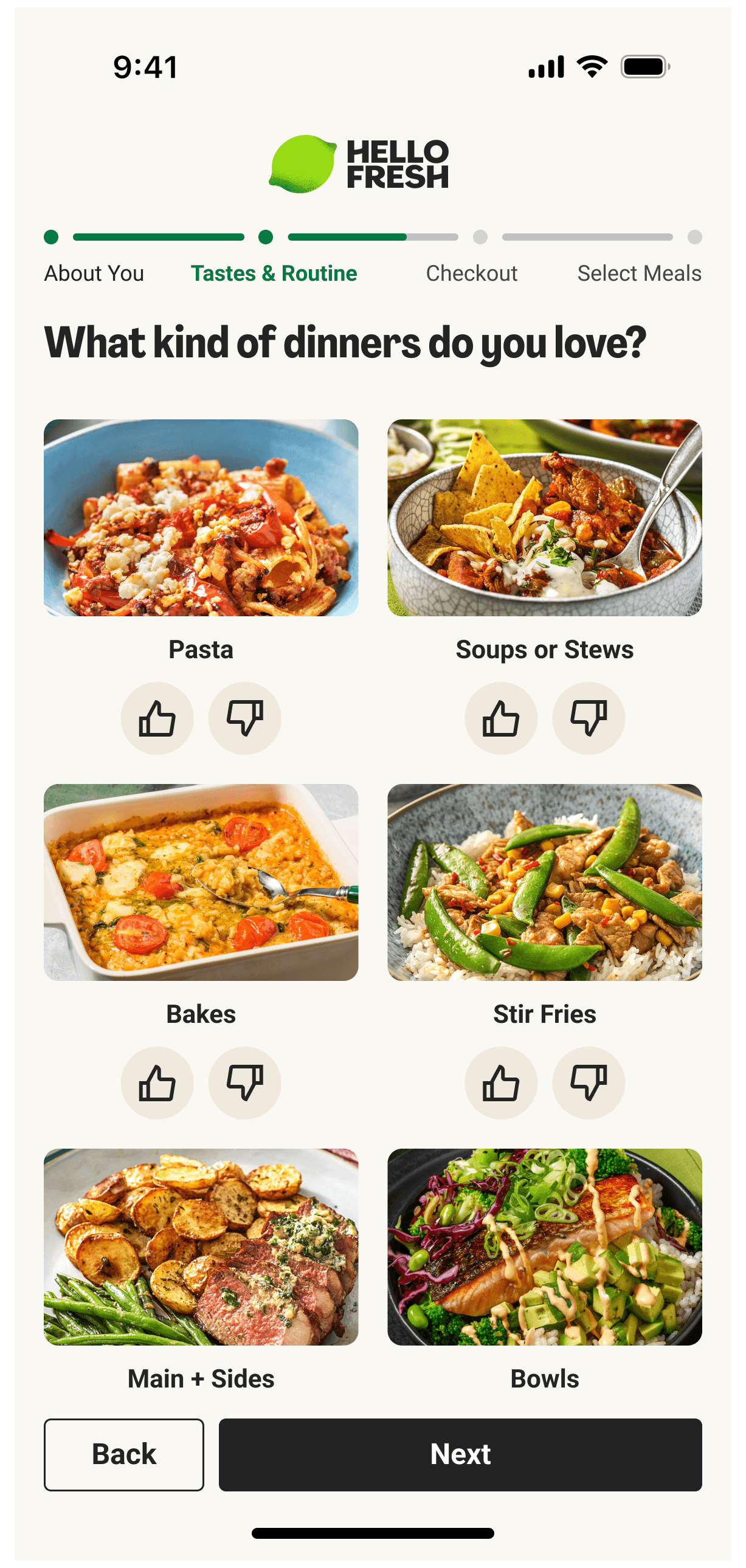
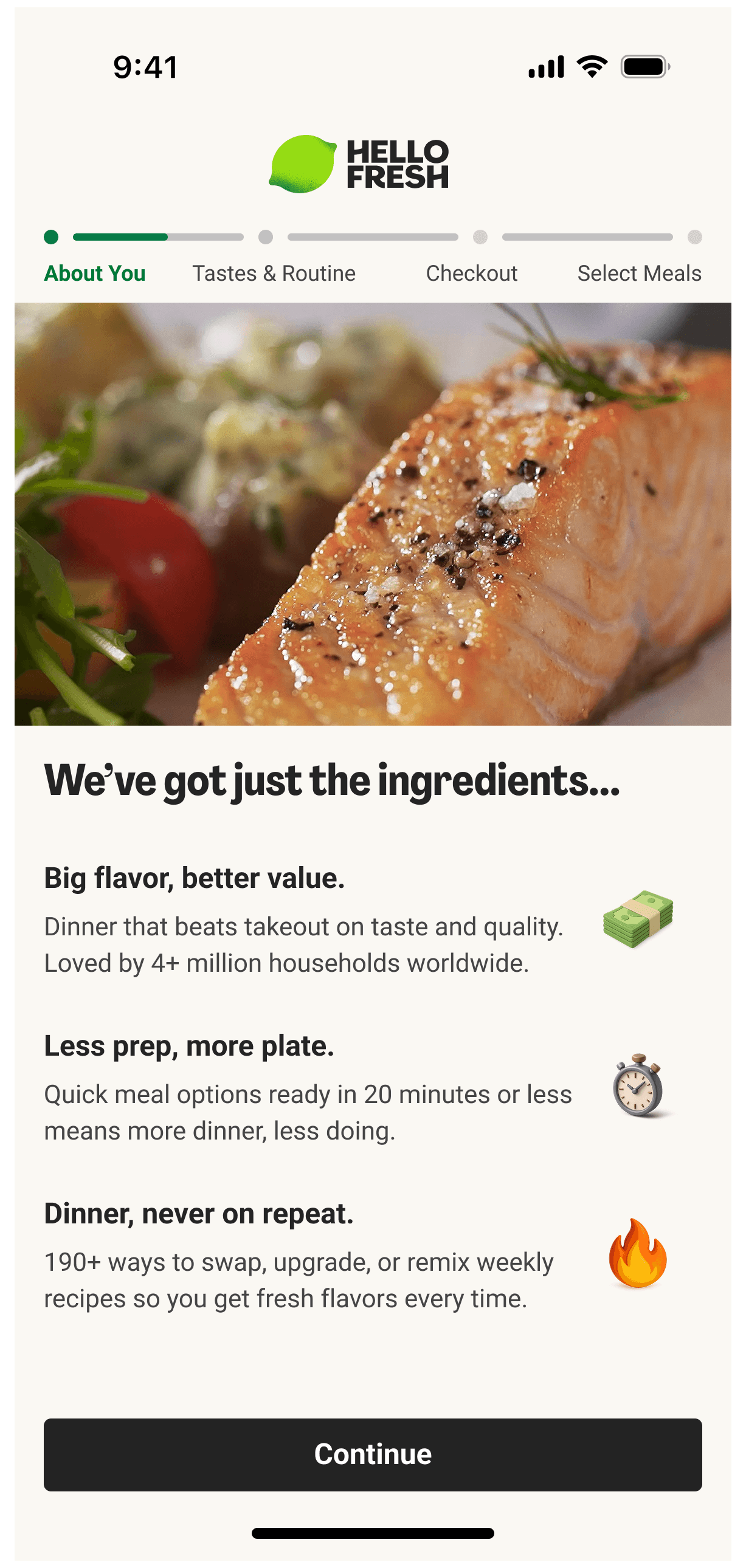
To reduce fatigue, I introduced more recipe imagery throughout the experience. These visuals helped balance out text-heavy screens while enticing prospective customers with the meals that awaited them
Personal goals
Before
After
Moment of assurance
Before
After
Nutrition preferences
Before
After
Setting the table
Enticing visuals alone weren't enough.
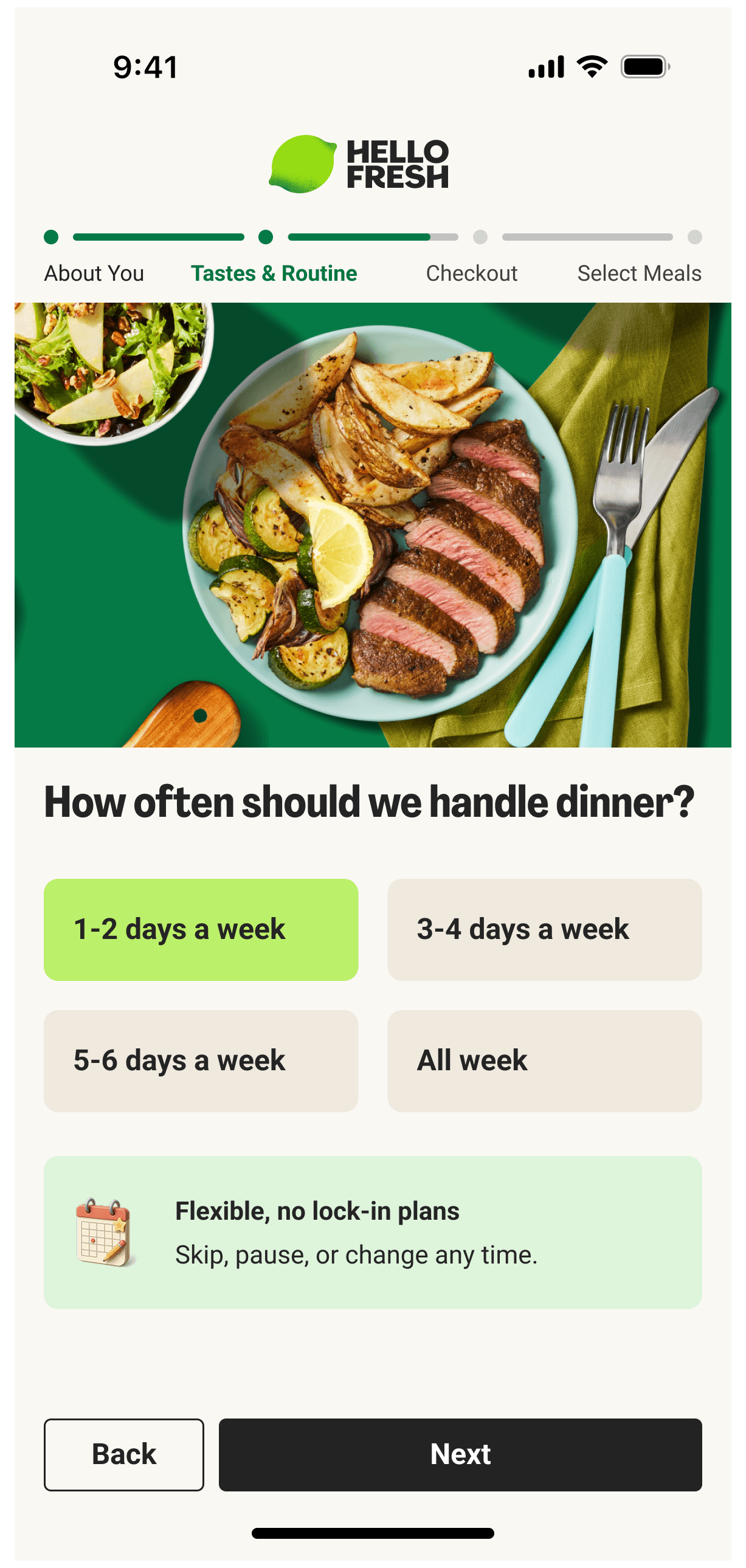
I wanted interaction design to do heavier lifting — not just exciting prospective customers about the menu, but setting honest expectations about serving sizes before their first box arrived. The user journey doesn't end at checkout; it extends to the moment someone opens that box and starts cooking. Designing for that full arc meant reducing the gap between what users anticipated and what they actually experienced.
Cooking frequency
Before
After
Same dish, better presentation
Inclusivity wasn't an afterthought — it was a design constraint. With millions of customers across vastly different households, a one-size-fits-all visual approach was never going to work. Nowhere was this more apparent than in the household module, where I was asking users how many people they cook for
My first instinct was photography of families eating together. But no combination of images could authentically represent the full spectrum of households we served — and choosing one interpretation meant excluding another. The solution came from stepping back from faces entirely. Hands reaching into frame, holding food, became the visual language instead. Hands are universal. They don't prescribe what a household should look like — they simply invite everyone into the same moment.
Household size
Before
After
What difference was made?
5%
increase in gross conversion rates
Boost in the number of new users successfully creating a HelloFresh account and subscribing
3%
increase in net conversion rates
Growing number of users successfully ordering and receiving their first box post-checkout
6%
increase in average order rate
More users consistently coming back to more boxes after their initial order
HelloFresh
‘25-
Context
I crafted
a personalized sign-up
funnel that communicates
HelloFresh's
value proposition,
improving retention rates and
increasing net conversions
Role
Senior Product Designer
Results
+5%
gross conversions
+3%
net conversions
+6%
average order handle
Final deliverable
(legacy approaches)
Prior to this project, the HelloFresh onboarding funnel included seven questions focused mainly on customer goals. While adding questions about flavor and ingredient preferences risked increasing completion time and drop-off, I hypothesized that users who completed a more in-depth onboarding would be more invested from the start—creating an opportunity to drive stronger long-term engagement and loyalty
Old funnel
8 min
Zip code
Zip code is in network
Zip code not in network
01.
Meal preferences
02.
Dietary preferences
03.
Personal goals
04.
Meals of interest
05.
Cooking frequency
06.
No. people at table
07.
Meal plan overview
Transactional conversions
‘11-’25
(testing concepts)
In collaboration with the UX research team, I tested the updated flow with multiple users. While the signup process took longer to complete, users did not find it tedious. In fact, many appreciated the deeper questions, noting that it set clear expectations for more personalization
New funnel
20 min
Zip code
Zip code is in network
Zip code not in network
01.
Personal goals
02.
Meals of interest
03.
Dietary habits
04.
Ingredients to avoid
(new)
05.
Nutrition preferences
(new)
06.
Favorite cuisines
(new)
07.
Favorite flavors
(new)
08.
Protein preference
(new)
09.
Dinner preference
(new)
10.
Cooking frequency
11.
No. people at table
Personalization focused
‘25-
"Make it more delicious"
The FoodTech equivalent of “make it pop.”
To reduce fatigue, I introduced more recipe imagery throughout the experience. These visuals helped balance out text-heavy screens while enticing prospective customers with the meals that awaited them
Personal goals
Before
After
Moment of assurance
Before
After
Nutrition preferences
Before
After
Setting the table
Enticing visuals alone weren't enough.
I wanted interaction design to do heavier lifting — not just exciting prospective customers about the menu, but setting honest expectations about serving sizes before their first box arrived. The user journey doesn't end at checkout; it extends to the moment someone opens that box and starts cooking. Designing for that full arc meant reducing the gap between what users anticipated and what they actually experienced.
Cooking frequency
Before
After
Same dish, better presentation
Inclusivity wasn't an afterthought — it was a design constraint. With millions of customers across vastly different households, a one-size-fits-all visual approach was never going to work. Nowhere was this more apparent than in the household module, where I was asking users how many people they cook for
My first instinct was photography of families eating together. But no combination of images could authentically represent the full spectrum of households we served — and choosing one interpretation meant excluding another. The solution came from stepping back from faces entirely. Hands reaching into frame, holding food, became the visual language instead. Hands are universal. They don't prescribe what a household should look like — they simply invite everyone into the same moment.
Household size
Before
After
What difference was made?
5%
increase in gross conversion rates
Boost in the number of new users successfully creating a HelloFresh account and subscribing
3%
increase in net conversion rates
Growing number of users successfully ordering and receiving their first box post-checkout
6%
increase in average order rate
More users consistently coming back to more boxes after their initial order
HelloFresh
‘25-
Context
I crafted
a personalized sign-up
funnel that communicates
HelloFresh's
value proposition,
improving retention rates and
increasing net conversions
Role
Senior Product Designer
Results
+5%
gross conversions
+3%
net conversions
+6%
average order handle
Final deliverable
(legacy approaches)
Prior to this project, the HelloFresh onboarding funnel included seven questions focused mainly on customer goals. While adding questions about flavor and ingredient preferences risked increasing completion time and drop-off, I hypothesized that users who completed a more in-depth onboarding would be more invested from the start—creating an opportunity to drive stronger long-term engagement and loyalty
Old funnel
8 min
Zip code
Zip code is in network
Zip code not in network
01.
Meal preferences
02.
Dietary preferences
03.
Personal goals
04.
Meals of interest
05.
Cooking frequency
06.
No. people at table
07.
Meal plan overview
Transactional conversions
‘11-’25
(testing concepts)
In collaboration with the UX research team, I tested the updated flow with multiple users. While the signup process took longer to complete, users did not find it tedious. In fact, many appreciated the deeper questions, noting that it set clear expectations for more personalization
New funnel
20 min
Zip code
Zip code is in network
Zip code not in network
01.
Personal goals
02.
Meals of interest
03.
Dietary habits
04.
Ingredients to avoid
(new)
05.
Nutrition preferences
(new)
06.
Favorite cuisines
(new)
07.
Favorite flavors
(new)
08.
Protein preference
(new)
09.
Dinner preference
(new)
10.
Cooking frequency
11.
No. people at table
Personalization focused
‘25-
"Make it more delicious"
The FoodTech equivalent of “make it pop.”
To reduce fatigue, I introduced more recipe imagery throughout the experience. These visuals helped balance out text-heavy screens while enticing prospective customers with the meals that awaited them
Personal goals
Before
After
Moment of assurance
Before
After
Nutrition preferences
Before
After
Setting the table
Enticing visuals alone weren't enough.
I wanted interaction design to do heavier lifting — not just exciting prospective customers about the menu, but setting honest expectations about serving sizes before their first box arrived. The user journey doesn't end at checkout; it extends to the moment someone opens that box and starts cooking. Designing for that full arc meant reducing the gap between what users anticipated and what they actually experienced.
Cooking frequency
Before
After
Same dish, better presentation
Inclusivity wasn't an afterthought — it was a design constraint. With millions of customers across vastly different households, a one-size-fits-all visual approach was never going to work. Nowhere was this more apparent than in the household module, where I was asking users how many people they cook for
My first instinct was photography of families eating together. But no combination of images could authentically represent the full spectrum of households we served — and choosing one interpretation meant excluding another. The solution came from stepping back from faces entirely. Hands reaching into frame, holding food, became the visual language instead. Hands are universal. They don't prescribe what a household should look like — they simply invite everyone into the same moment.
Household size
Before
After
What difference was made?
5%
increase in gross conversion rates
Boost in the number of new users successfully creating a HelloFresh account and subscribing
3%
increase in net conversion rates
Growing number of users successfully ordering and receiving their first box post-checkout
6%
increase in average order rate
More users consistently coming back to more boxes after their initial order